
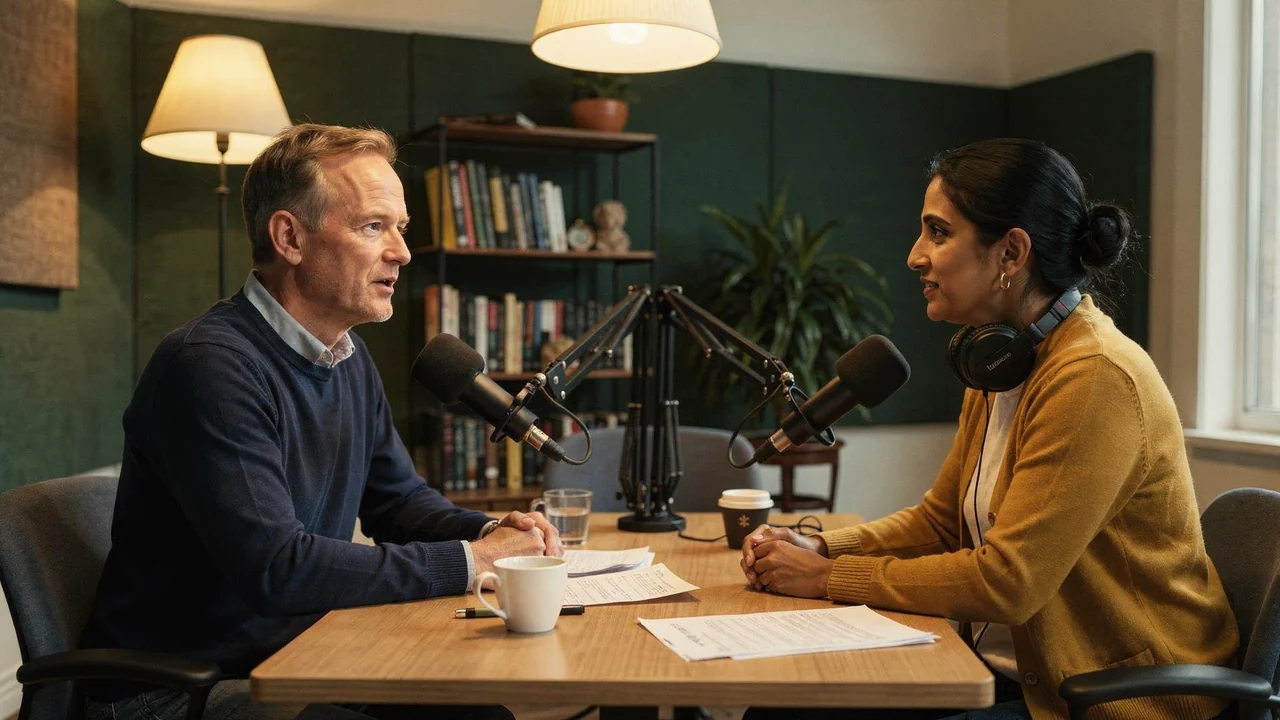
Episode 4: How to ask a whistleblower questions
The pictures and voices are AI-generated.
Podcast · 6 minEpisode 4: How to ask a whistleblower questions
Priya and James talk about how to question a whistleblower: the eight questions a report should answer, open questions, respect, and how to bring out what matters without scaring anyone off.
Read the article → Listen on Spotify RSS
Read the transcript
JamesHi, and welcome to Whistleblowing in practice, a podcast from Trustcom. I'm James.
PriyaAnd I'm Priya.
JamesToday it's all about questions. You've received a report, it's pretty thin, and you need to know more.
PriyaThat's everyday life. Most reports are missing something the first time.
JamesIs that a problem?
PriyaNo, it's normal. The person reporting is often nervous and writes very little. And Norwegian law doesn't ask for more.
JamesNo formal requirements?
PriyaNone. A report can be spoken, it can be three lines, and the whistleblower doesn't need proof.
JamesSo if I think the report is too vague, I can't just put it aside.
PriyaNo. The employer has to investigate the report within a reasonable time. If something is missing, it's your job to ask.
JamesFine. What do I actually need to know?
PriyaI think of eight questions. What happened? Who was involved? Where did it happen?
JamesThat's three.
PriyaHow was it discovered? When did it happen? Has it happened more than once?
JamesSix.
PriyaWere there witnesses? And is there any documentation?
JamesThey're quite simple.
PriyaThat's the point. Notice that none of them asks the whistleblower to draw a conclusion. They ask for observations.
JamesSo what the person has seen and heard.
PriyaYes. The whistleblower isn't meant to decide whether someone broke the law. That's our job.
JamesWhy is "how was it discovered" in there? I wouldn't have thought of that.
PriyaBecause it tells you how solid the information is. There's a difference between "I saw it myself" and "I heard it at lunch".
JamesAnd maybe where to find traces.
PriyaExactly. If someone spotted it in a report, you know where to look.
JamesShould these questions be in the reporting form itself?
PriyaYes, but as help. Not as required fields.
JamesWhy not required? Then I'd get complete reports.
PriyaYou'd get fewer reports. Someone who saw something once, with no witnesses and no documents, gives up.
JamesSo an open text field, with the questions next to it.
PriyaYes. And a friendly tone. "Please be as specific as you can", not "reports without documentation will not be processed".
JamesThat last one is also wrong, isn't it?
PriyaIt is wrong. An incomplete report is still a report.
JamesSay the report is in, and I need to ask follow-up questions. Where do I start?
PriyaBy saying thank you. It sounds trivial, but it sets the tone.
JamesAnd then?
PriyaOpen questions. "Can you tell me more about what happened?"
JamesInstead of?
PriyaInstead of "was it your manager who did it?". That's a leading question. You're putting the answer in their mouth.
JamesI tend to ask five questions in the same message.
PriyaMost people do. Then you get an answer to the easiest one, and the rest disappear.
JamesOne at a time, then.
PriyaOne at a time. And explain why you're asking.
JamesDo you have an example?
Priya"We're asking about the time because we want to check the access log." Then the whistleblower understands it isn't distrust.
JamesAre there questions I should stay away from?
Priya"Why didn't you say something earlier?"
JamesI've probably asked that.
PriyaIt sounds like an accusation, even if you're only curious. Ask instead what made the person speak up now.
JamesWhat about motive? Should I ask why they're reporting?
PriyaNo. Motive doesn't decide whether the report has to be investigated. Someone who reports in the middle of a conflict is protected too.
JamesAnd if the whistleblower doesn't know the answer to what I'm asking?
PriyaThen that has to be fine. Say it outright: "It's perfectly all right to answer that you don't know."
JamesOtherwise people start guessing.
PriyaYes, and guesses are worse than gaps.
JamesWhat about anonymous whistleblowers? Can I ask questions at all?
PriyaYes, if the channel supports it. The whistleblower signs in again with their code and answers there.
JamesAnything I need to watch out for?
PriyaDon't ask anything that could reveal who it is. "Which department do you work in?" can be enough to single out one person.
JamesYou don't always think of that.
PriyaNo. And it applies to attachments too. A photo or a document can carry traces of who made it.
JamesSo if I show a screenshot to the person who was reported?
PriyaThen you may in practice have revealed the whistleblower. Think before you pass attachments on.
JamesCan you give me an example of a bad message and a good one?
PriyaBad: "You write that timesheets are being falsified. Who is it about, when did it happen, how do you know, and do you have proof?"
JamesThat sounds like an interrogation.
PriyaIt does. Better: "Thank you for speaking up. To look into this we need to know a little more. Can you tell us what you've seen or heard that makes you think the timesheets are wrong?"
JamesSame information, completely different feeling.
PriyaAnd you get more back.
JamesWhat do I say at the end of a conversation like that?
PriyaWhat happens next, and roughly when they'll hear from you. And that they should tell you if they experience negative reactions.
JamesAnd then I write it down.
PriyaAlways. Notes from the conversation, and let the whistleblower read them through if you can.
JamesSo to sum up: eight simple questions as help, open questions one at a time, explain why you're asking, and never anything that could reveal an anonymous whistleblower.
PriyaAnd remember to say thank you.
JamesYou'll find the article on what a report should include at trustcom.io. There's also a free course there for people who receive reports.
PriyaThanks for listening. Talk to you in the next episode.
Two of our six regular hosts cover one whistleblowing topic per episode, in fifteen minutes or less. The voices are AI-generated; the content is written and fact-checked by Trustcom.